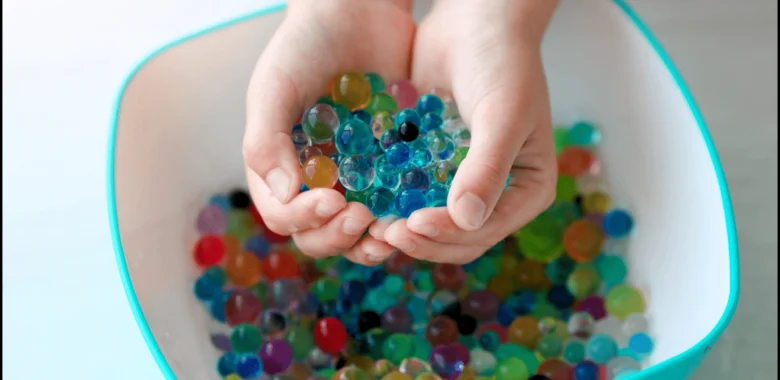

You drop a small packet of Orbeez into a bowl of water and walk away. An hour later you come back expecting nothing. What you find instead is a bowl full of squishy, translucent spheres that have grown to the size of small marbles. If you have not seen Orbeez grow before, it is genuinely surprising how dramatically they change.
This guide answers every practical question about Orbeez: how long they take to reach full size, what affects how big they get, how to grow them correctly, what to do when they are not growing properly, how long they last, and how to dispose of them safely. Whether you are buying them for the first time or troubleshooting a batch that is not growing as expected, everything you need is here.
Orbeez Quick Reference Guide
| Time to full size | 4 to 6 hours in warm water |
| Maximum diameter | About 14mm (marble-sized) |
| Volume increase | Up to 100x original dry volume |
| Best water type | Distilled or filtered — minerals in tap water limit size |
| How long they last | 1-2 weeks hydrated; months if dried and re-grown |
| Can you flush them? | Never — causes pipe blockages |
| Safe for children? | Not for children under 3 — choking and ingestion hazard |
How Long Do Orbeez Take to Grow?
Standard Orbeez reach their full size in four to six hours when placed in clean water at room temperature. The growth is not linear — there are distinct phases. In the first thirty minutes, the beads visibly swell as they rapidly absorb water. By the one-hour mark they have expanded substantially, already looking much closer to their finished size than their original tiny dry pellets. Over the next three to five hours, growth continues more gradually as the beads approach the equilibrium point where they have absorbed as much water as their polymer structure can hold.
Using warm water speeds this process because heat increases the kinetic energy of water molecules, allowing them to penetrate the polymer network faster. Room temperature water works but takes toward the longer end of the range. Cold water significantly slows growth. Do not use boiling water — temperatures above around 90°C begin to degrade the polymer structure, producing beads that are soft and mushy rather than firm and fully round.
Quantity affects timing in a non-obvious way. A small number of Orbeez in a large amount of water will reach full size faster than a large number in a smaller amount of water. The reason is concentration — as Orbeez absorb water, the ratio of available water per bead drops. If there is not enough water to fully supply each bead, growth stops short of maximum size. The standard recommendation is to use much more water than you think you need. You can always drain the excess when growth is complete.

What Are Orbeez Made Of?
Orbeez are superabsorbent polymer beads made from cross-linked sodium polyacrylate — the same material used in disposable diapers, sanitary products, and certain agricultural water-retention applications. The chemistry behind their growth explains both their impressive size change and their limitations.
In their dry state, the sodium polyacrylate polymer chains are tightly coiled and compressed. The cross-links between chains create a three-dimensional network with an enormous number of water-absorbing sites throughout the structure. When the bead contacts water, osmotic pressure drives water molecules into the polymer network. The chains unfold and the cross-linked network swells, maintaining its shape while expanding dramatically in volume.
Sodium polyacrylate can absorb 200 to 300 times its dry weight in distilled water under ideal laboratory conditions. In tap water, dissolved minerals — particularly calcium and magnesium ions in hard water — compete with sodium ions in the polymer, reducing the osmotic pressure that drives absorption. This is why tap water consistently produces smaller Orbeez than filtered or distilled water. The mineral competition is not harmful, it simply limits how much the polymer can expand.

How to Grow Orbeez: The Complete Step-by-Step Guide
Growing Orbeez for Maximum Size and Best Results
-
1
Choose a large container. Select a container with at least four to five times the volume of your finished Orbeez. They expand dramatically — a tablespoon of dry beads fills a large mixing bowl when fully grown. Underestimating container size is the most common mistake beginners make.
-
2
Use warm, clean water — and plenty of it. For best results, use filtered or distilled water warmed to around 70-80°F (slightly warm to the touch, not hot). Use at least one cup of water per teaspoon of dry beads. This is more than you think you need — excess water is fine and helps ensure each bead reaches full size.
-
3
Add the dry beads and spread them out. Pour the beads into the water evenly. Do not let them pile up in one spot, as clumped beads absorb water unevenly. Gently stir once to separate any that are stuck together, then leave undisturbed.
-
4
Wait 4-6 hours without disturbing them. The beads are fragile while absorbing water. Handling or squeezing them during growth can deform them or cause them to break. Check at the 4-hour mark. If they are still growing, give them another hour or two.
-
5
Test for full growth. Fully grown Orbeez are firm and round, not soft or misshapen. They should feel smooth and slightly springy — not mushy or sticky. If they are soft or tacky, they may not have reached full size or may have started to degrade.
-
6
Drain excess water through a strainer or colander. Do not pour Orbeez down the drain — even through a strainer, small amounts escape and can accumulate in pipes. Drain over a bucket and empty the bucket into the garden, or use a fine mesh bag.
Why Are My Orbeez Not Growing? Troubleshooting Guide
| Problem | Most Likely Cause | Solution |
|---|---|---|
| Not growing at all | Not enough water, or beads are expired/damaged | Add much more water; check the packet expiry date |
| Smaller than expected | Hard tap water with high mineral content | Use filtered or distilled water for noticeably larger results |
| Growing slowly | Cold water temperature | Use warm water — 70-80°F accelerates absorption significantly |
| Uneven sizes in same batch | Beads clumped together at start; uneven water access | Stir gently when adding to water to separate beads |
| Mushy or breaking apart | Left too long, handled too early, or boiling water used | Drain promptly at 6 hours; handle gently; never use boiling water |
| Sticky or tacky surface | Beginning to degrade or contaminated water | Use fresh clean water; replace batch if stickiness persists |

How to Get the Biggest Orbeez Possible
If you want to maximize the size of your Orbeez beyond what standard tap water achieves, there are several factors you can optimize.
Use distilled water. This makes the single biggest difference. The mineral ions in tap water — particularly calcium and magnesium — interfere with the osmotic absorption process. Distilled water contains none of these competing ions, allowing the polymer to absorb to its maximum potential. Most supermarkets sell distilled water cheaply, and the size difference compared to hard tap water is visibly noticeable.
Use warm water throughout the process. Start with warm water (not hot, not boiling — around 70-80°F) and keep the container in a warm room. If you start with warm water and the room is cold, the water temperature drops as growth continues and the process slows. Keeping the container in a consistently warm environment throughout the full growth period produces consistently larger results.
Use a generous water ratio. As a rule of thumb, use three to four times as much water as you think you need. Excess water does not make the beads larger, but insufficient water prevents them from reaching their maximum size. Err heavily on the side of more water rather than less.
Grow for the full six hours. Many people check their Orbeez at the four-hour mark, see that they have grown substantially, and assume they are done. They are usually still growing. The final hour or two of the growth period produces smaller incremental changes, but cumulatively they add up. Leave them for the full six hours before concluding growth is complete.

How Long Do Orbeez Last?
Fully hydrated Orbeez in a sealed container at room temperature last one to two weeks before they begin to shrink, become cloudy, or develop surface stickiness that indicates the beginning of polymer degradation. Keeping them in the refrigerator extends this to around three to four weeks. Once they develop a slippery or slimy texture, an unusual odor, or visible cloudiness that was not present when they were fresh, they have begun to degrade and should be replaced.
Orbeez can be successfully dried out and re-grown multiple times. Spread them on a flat, dry surface in a well-ventilated area — a baking sheet works well — and allow them to dehydrate over 24 to 48 hours in a warm, dry environment. They will contract back toward their original size, sometimes retaining slightly more volume than they started with due to imperfect re-coiling of the polymer chains. Re-grow them using the same process described above. The quality of re-grown Orbeez is slightly lower than the first growth — they tend to be slightly smaller and less uniformly round — but they are still functional for most applications.
| Storage Method | Expected Lifespan | Notes |
|---|---|---|
| Open container, room temp | 3-5 days | Evaporation causes shrinkage; add water to maintain |
| Sealed container, room temp | 1-2 weeks | Best everyday storage method |
| Sealed container, refrigerated | 3-4 weeks | Slows degradation significantly |
| Fully dried (dehydrated) | Months to years | Best long-term storage; re-grow as needed |
Safe Disposal of Orbeez
Never dispose of Orbeez by flushing them down the toilet or pouring them down a drain. This is one of the most common disposal mistakes and one of the most reliably damaging ones. Orbeez that enter a drain pipe continue absorbing water — they do not stop at their maximum growth size, they just grow more slowly. Partially dried Orbeez that are smaller than their maximum size will absorb aggressively when they encounter the moisture in drain pipes. Even fully grown Orbeez can lodge in pipe joints and accumulate into a blockage over time. The same polymer chemistry that makes Orbeez impressive in a bowl makes them highly problematic in plumbing.
The correct disposal method is to place Orbeez in a sealed bag and put them in the household trash. For large quantities, dehydrate them first — they shrink dramatically and take up far less space in a trash bag when dry. Alternatively, Orbeez can be buried in garden soil. Sodium polyacrylate is used intentionally in horticulture as a water-retaining amendment for dry soils, and it does eventually break down in soil environments over months to a few years. It is not harmful to plants in moderate quantities.
Safety Information
Orbeez are non-toxic — the polymer sodium polyacrylate has a very low toxicity profile and is the same material used in products designed to contact skin and absorb bodily fluids. However, they are not safe for young children for a specific reason: ingestion. A dry Orbeez bead that is swallowed continues expanding in the stomach and intestines, where it can cause an obstruction. This is a documented medical hazard. Children under three should not have access to Orbeez in any form — dry or grown.
Older children (age four and up) can use Orbeez safely under adult supervision when the activity is structured to prevent putting them in the mouth. Sensory play bins, spa-style foot soaks, and decorative vases are all common uses that are appropriate for older children with reasonable supervision.
Frequently Asked Questions
How long do Orbeez take to grow to full size?
Four to six hours in warm water at room temperature. Using warm filtered or distilled water achieves maximum size in four hours. Cold water or tap water with high mineral content may take the full six hours and produce smaller results.
How big do Orbeez get?
A standard Orbeez bead grows from about 1 millimeter dry to approximately 14 millimeters fully hydrated in distilled water — roughly the size of a marble. The total volume increase is up to 100 times the original dry volume. In hard tap water, maximum size is typically somewhat smaller due to mineral interference.
Can Orbeez be flushed down the toilet?
No — never. Orbeez continue absorbing water inside pipes and can grow large enough to cause significant blockages. Even small amounts flushed regularly accumulate at pipe joints and bends. Always dispose of Orbeez in the trash, either in a sealed bag or after drying them out first.
How many times can you re-grow Orbeez?
Most batches can be grown, dried, and re-grown three to five times before the quality deteriorates noticeably. Each cycle of growth and drying slightly degrades the polymer structure, resulting in beads that are somewhat smaller and less uniformly round with each subsequent growth. For display or decorative use where appearance matters, fresh growth each time produces the best results.
Do Orbeez grow faster in hot water?
Warm water (70-80°F) speeds growth compared to cold or room-temperature water. Truly hot water above about 90°C starts to degrade the polymer and produces soft, deformed beads rather than firm, round ones. Warm is better than hot. The biggest improvement in size comes from water quality — switching from hard tap water to distilled water produces a more significant size difference than temperature alone.
Are Orbeez safe for the environment?
Sodium polyacrylate does break down in soil environments over a period of months to a few years through hydrolysis and microbial activity. It is used intentionally in horticulture, so burying Orbeez in garden soil is a reasonable disposal option in small quantities. They should not be flushed into the water system or left in large quantities in natural environments. For household quantities, the sealed bag in the trash is the simplest and most reliable disposal method.
For more home activity guides, sensory play ideas, and practical home care tips, browse our DIY Projects section.
Related Reading